A Dedicated Trust Center Is Now Included With Public Lovable Apps
By Lovable Student · Published 5 Aug 2026 · Updated 28 Sept 2026
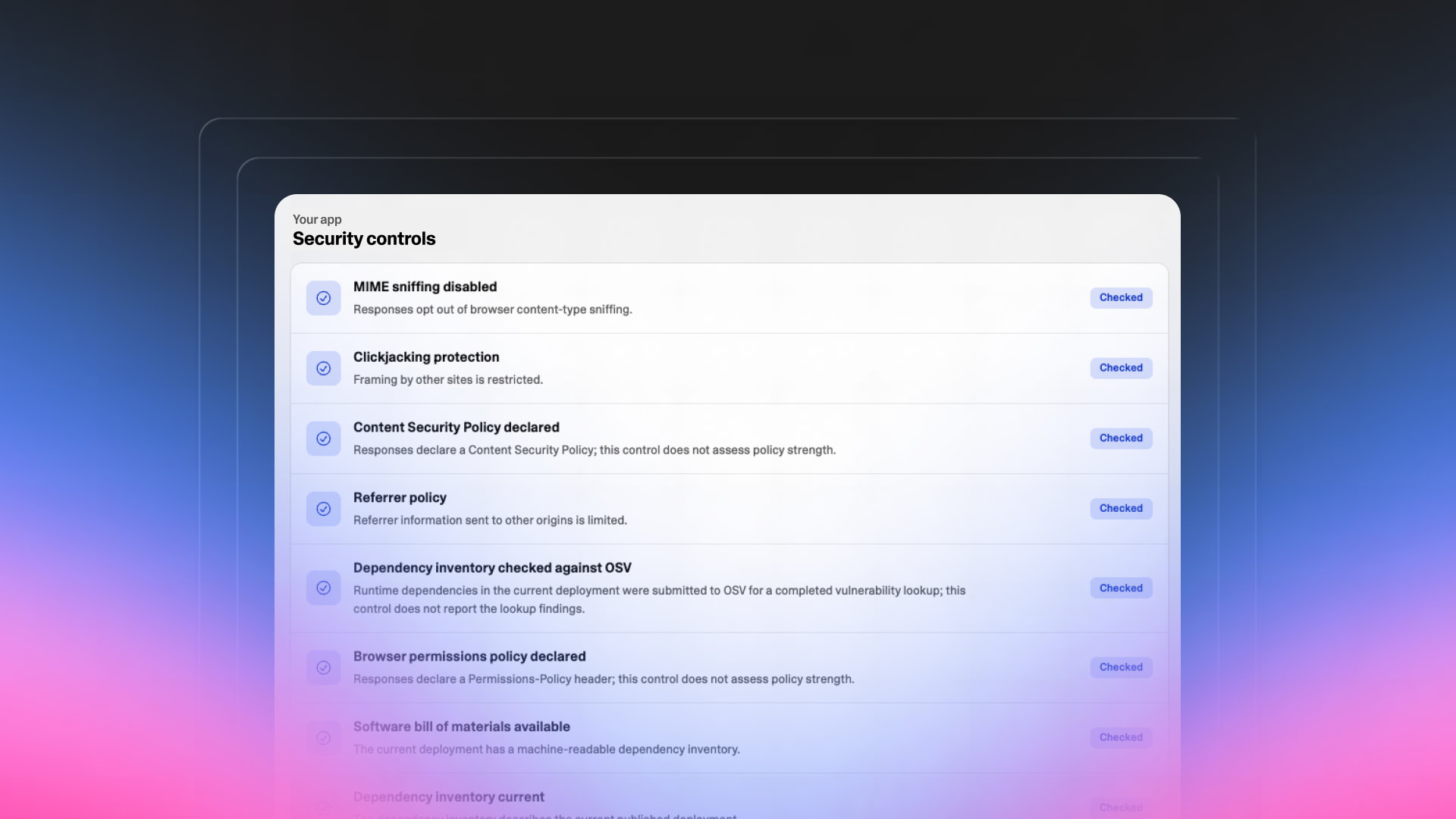
Lovable has introduced an automatically generated trust center for every app published publicly on the platform. The page lives at `YOURAPPURL/.well-known/trust.html` and reports security controls Lovable can observe directly from the deployed application.
- news
- Lovable
- Trust Centers
- AI App Builder
Summary
Lovable has introduced an automatically generated trust center for every
app published publicly on the platform. The page lives at
YOURAPPURL/.well-known/trust.html and reports security controls
Lovable can observe directly from the deployed application.
The trust center can show HTTPS and TLS protections, browser security headers, secure cookie observations, dependency vulnerability checks against Google's OSV database, a CycloneDX software bill of materials, deployment traceability, health monitoring, database authorization review, row-level security status, automated security remediation, and connected Aikido assessment information.
Builders do not manually fill in or style this page. Lovable generates it from the current published deployment, and application code cannot edit it. Lovable also explicitly states that a trust center is not a certification and does not mean a business or application is automatically secure or compliant.
At launch, trust centers apply to apps published publicly rather than only within a workspace. Lovable says additional information such as backend services, data residency, AI gateway controls, and subprocessors is planned for the trust page in the future.
Original Source
Read the original announcement
What This Means for Lovable Users
For founders and agencies selling software to businesses, this gives customers, investors, and IT reviewers a direct place to inspect platform-level security information instead of relying entirely on a questionnaire or sales email.
The strongest use is evidence, not marketing language. A trust center can show observed controls and deployment information, but builders should not present it as proof that application-specific business logic, authorization, data retention, or compliance obligations are correct.
If you are preparing a B2B Lovable app, add the trust-center URL to your security documentation and review what it actually reports before sharing it with a customer.
What This Means for Lovable and the Broader Community
This update is another sign that Lovable is expanding beyond simple prompt-to-prototype workflows into a broader software platform covering production applications, integrations, enterprise governance, agent workflows, infrastructure, and ongoing application management.
Where this article describes future plans or a company direction, those should be treated as such rather than assumed to be generally available today. The practical significance depends on the feature, plan, external provider, and architecture involved.
Ways You Could Use This
Practical Idea 1
Add the trust-center URL to enterprise sales and procurement material.
Practical Idea 2
Review RLS and unresolved security findings before sending the page to a customer.
Practical Idea 3
Use the trust center alongside, not instead of, your privacy policy, DPA, and application-specific security documentation.
If you need expert help implementing, reviewing, troubleshooting, or planning a Lovable project around this update, PromptSites.com can help with Lovable builds and production implementation.
Should Existing Lovable Users Do Anything?
No migration is required. If you have a public Lovable app, open its
/.well-known/trust.html page and verify the information before using
it in sales or security reviews.
Key Takeaway
For founders and agencies selling software to businesses, this gives customers, investors, and IT reviewers a direct place to inspect platform-level security information instead of relying entirely on a questionnaire or sales email.
The safest approach is to use the capability where it solves a real project problem, verify the current availability and limitations, and test important production behavior rather than assuming an announcement automatically changes every existing Lovable project.
Sources
Was this post helpful?
