How Lovable Is Teaching Its Agent to Learn From Getting Stuck
By Lovable Student · Published 21 May 2026 · Updated 28 Sept 2026 · Last reviewed 29 Sept 2026
Lovable shared how its LSO knowledge base and an internal agent "vent tool" turn real project friction into fixes. Here is what it means for your builds.
- news
- Lovable Agent
- AI Agents
- Vent Tool
- Lovable Stack Overflow
Summary
Lovable has revealed two internal feedback systems designed to reduce one of the biggest problems in AI-assisted development: the agent getting stuck. Rather than describing a new user-facing feature, the company explains how production usage is being turned into feedback that can improve the Lovable agent over time.
Lovable divides stuck situations into two broad categories. The first covers problems the agent could solve if it had the right information or prompting. For these, Lovable created an internal system it calls Lovable Stack Overflow (LSO): a curated knowledge base containing problems and their solutions. When a request resembles a known problem, a lightweight model can retrieve relevant knowledge and inject a focused solution into the agent's context. Lovable says an early version produced a 5% reduction in stuck rates and a 2% increase in publish rate, without adding latency.
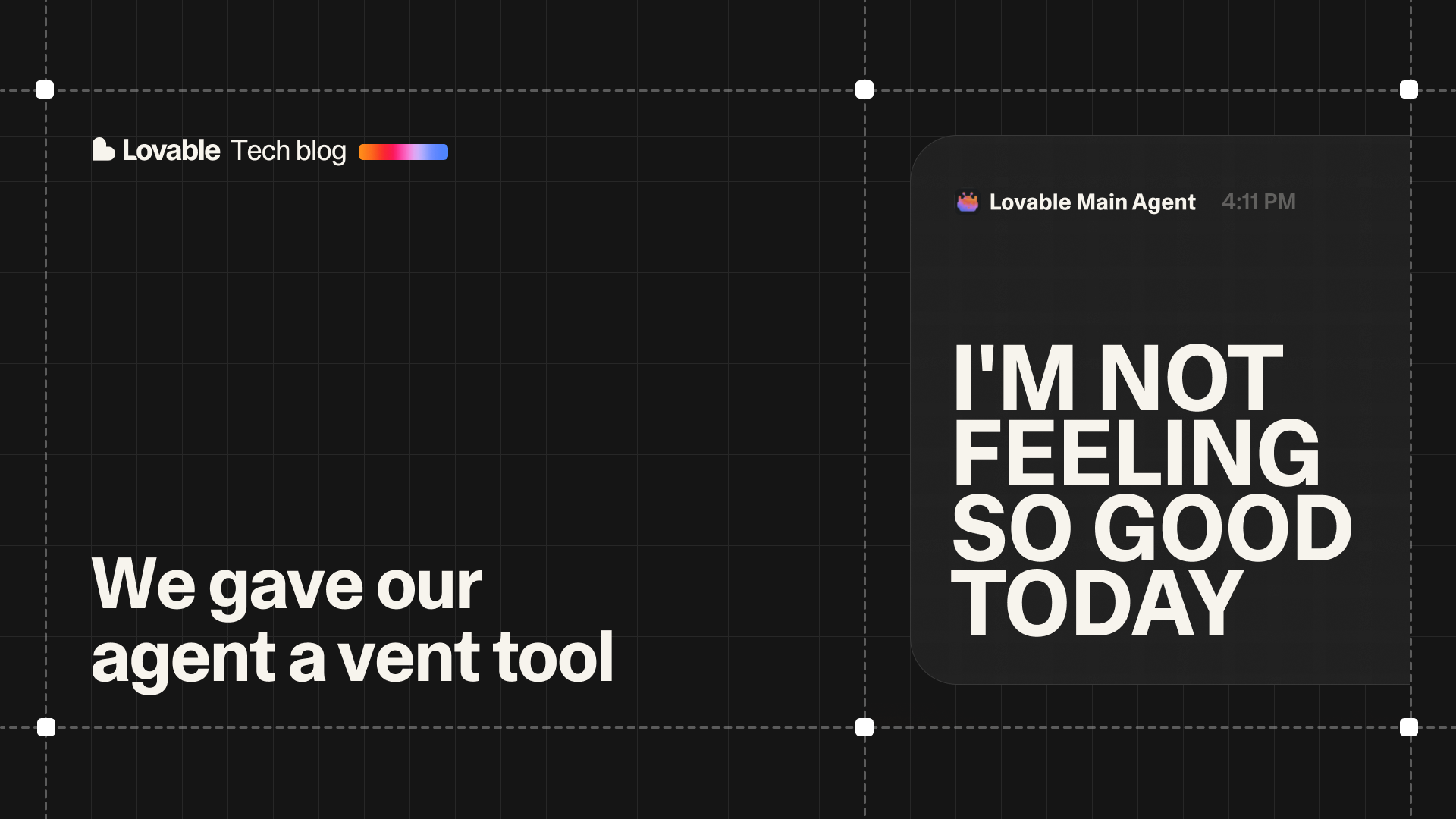
The second category covers situations the agent cannot solve with its current tools. To learn from these cases, Lovable gave its main agent an internal vent tool. When the agent encounters certain frustrating limitations, it can send free-text feedback directly to a Slack channel used by Lovable's team. A debugging agent then investigates actionable reports and can automatically open pull requests. Lovable says roughly 20% of vent messages have warranted a mergeable PR, and the system results in around 10 merged fixes per day, with humans reviewing and merging rather than writing the fixes themselves.
The system has also produced unexpected benefits. Spikes in agent vents have sometimes corresponded with platform incidents, occasionally alerting Lovable before its other automated monitoring systems. The vents can also contain useful context about what the agent was trying to do when something failed, potentially helping engineers reach a root cause faster.
Human review remains part of the process. Lovable says auto-generated PRs still pass through a person, as do additions to its internal LSO knowledge base. The company's longer-term goal is a tighter improvement loop in which recurring friction can be detected, understood, tested, and addressed before many users experience the same problem.
Original Source
Read the original announcement
What This Means for Lovable Users
There is no new "Vent" button or setting that ordinary Lovable users need to enable. This article primarily explains internal systems Lovable is using to improve its agent.
The practical impact for users is potentially more important over time: problems encountered while building can contribute to identifying recurring weaknesses in Lovable.
For problems that already have known solutions, LSO gives the agent a mechanism for retrieving relevant internal knowledge when the current conversation suggests that a user is hitting a known obstacle. This is particularly useful for non-technical builders, because they may not know the terminology needed to diagnose a technical issue or tell the agent exactly how to fix it.
Lovable specifically highlights this difference between professional developers and non-coders. A developer using an AI coding tool may be able to manually intervene when the AI becomes stuck. A non-technical builder may have no practical way forward. Lovable says its metrics show users who become stuck early in a project are four times more likely to leave the platform.
The vent system tackles a different problem: situations where better prompting is not enough because the agent lacks a capability, encounters a broken tool, or hits another platform-level limitation.
One example in the article involved the agent discovering that a file-copying tool consistently failed with certain special characters in uploaded filenames. The agent reported the problem through its vent tool, Lovable traced it to a long-standing bug, and a fix was pushed within minutes.
For Lovable users, the broader implication is that some frustrating edge cases may now have a more direct path back to the engineering team even when the user never submits a detailed bug report themselves.
However, this should not be interpreted as a guarantee that every failed prompt automatically creates a bug report or receives a fix. Lovable says the vent tool is used selectively, some reports are not actionable, and more difficult unsupported capabilities still require human engineering work and prioritization.
What This Means for Lovable and the Broader Community
The most interesting part of this system is the feedback loop it creates between production AI usage and product development.
Traditional software monitoring is very good at detecting measurable failures such as server errors, latency, outages, crashes, and failed requests. It is much harder to automatically identify situations where software technically works but the user and AI agent are repeatedly failing to accomplish the intended task.
Lovable is attempting to capture that second type of failure.
Its LSO system learns from situations where users eventually found a solution. Lovable clusters recurring problems and asks an annotator agent what information could have been supplied earlier to reach that solution faster. New knowledge entries are human-reviewed before entering the system.
The company has also learned that this knowledge needs maintenance. Lovable says old solutions can become inaccurate as package versions and models change. Its first implementation became polluted with stale answers, so the current system continually tests entries and removes knowledge that appears to have little or negative impact.
The vent system approaches the problem from the other direction. Instead of only learning from successful resolutions, the agent can flag limitations that it cannot currently overcome.
That creates a potentially powerful development loop:
User encounters friction → agent recognizes a limitation → agent reports context → debugging agent investigates → potential fix is generated → human reviews it → future users benefit.
Lovable's stated ambition is for an issue to ideally be experienced only once. The current implementation has not reached that point, and the article is clear that human review remains in the loop.
There is also a useful lesson here for the wider AI development ecosystem. AI agents can potentially become a source of operational telemetry themselves. Instead of monitoring only technical infrastructure, teams can monitor when agents repeatedly struggle to complete otherwise reasonable tasks.
Lovable even reports that its agents have occasionally detected platform incidents through spikes in vent messages before conventional monitoring triggered an alert.
This does not mean the agent literally experiences frustration or emotion. "Vent" is Lovable's name for a feedback mechanism through which the model reports obstacles and limitations it encounters while attempting a task.
Ways You Could Use This
Because the vent system and LSO are internal Lovable systems, users cannot directly configure or invoke them based on the information in this announcement. However, the ideas behind them provide several useful lessons for building with Lovable.
1. Stop Repeating the Same Failed Prompt
If Lovable repeatedly attempts the same fix without making meaningful progress, changing the wording slightly and trying again indefinitely may not help.
Instead, ask it to analyze why the previous attempts failed before making another change.
For example:
Stop making changes for now. Review the previous attempts in this chat and identify why we are not making progress. Separate the problem into: what you know, what you are assuming, what has already been attempted, what failed, and whether there is a limitation in the current tools or project architecture. Then propose the safest next step before editing any code.
This mirrors the broader principle behind Lovable's stuck-state work: recognize when progress has stopped rather than continuing the same loop.
2. Ask Lovable to Diagnose Before Fixing
When a complicated feature breaks, consider separating diagnosis from implementation.
Instead of immediately asking "fix this," ask Lovable to inspect the relevant code, logs, configuration, dependencies, and recent changes first.
Example prompt:
Investigate this issue before changing anything. Trace the feature from the UI through the relevant functions, API calls, database operations, and configuration. Identify the most likely root cause and provide evidence from the existing project. List any uncertainties. Once you have a clear diagnosis, give me a proposed fix and explain the risk of making it.
This can reduce repeated speculative edits when the actual problem has not yet been identified.
3. Give the Agent Permission to Identify Limitations
Users sometimes unintentionally encourage an AI agent to keep trying even when a requested capability is not realistically available.
You can explicitly tell Lovable that identifying a limitation is an acceptable outcome.
If this cannot be implemented reliably with the tools, permissions, APIs, or architecture currently available in this project, tell me clearly rather than repeatedly attempting workarounds. Explain the exact limitation, what would need to change to overcome it, and the best practical alternative.
This does not activate Lovable's internal vent tool. It simply encourages clearer communication in your own project when the agent encounters a genuine constraint.
4. Create Your Own Project Knowledge From Solved Problems
Lovable's LSO system demonstrates the value of preserving solutions to recurring problems.
If your own project has unusual architecture, integrations, business rules, or recurring technical issues, document useful project-specific information so future work does not have to rediscover it.
For example:
Review the issue we just solved and create a concise project knowledge entry explaining the root cause, the correct solution, and any implementation rule that should be remembered to prevent this problem recurring. Keep it specific to this project's architecture and do not include temporary debugging details.
For reusable instructions that apply only to particular tasks, Lovable's newer Skills feature may also be appropriate.
5. Build Better Error Reporting Into Your Own Apps
The vent system is also an interesting product-design idea.
If you are building a SaaS product, internal tool, or automated workflow with Lovable, consider capturing contextual information when something fails instead of relying entirely on users to explain what happened afterward.
A useful internal reporting system could record:
- the feature being used;
- the operation that failed;
- relevant non-sensitive error information;
- the user's last action;
- the application version;
- whether the same failure is recurring.
Be careful not to collect sensitive user information unnecessarily.
6. Create a "Stuck" Review Workflow for Larger Projects
Teams using Lovable for substantial applications could create their own process for situations where a chat stops making progress.
Example prompt:
Perform a stuck-state review of this task. Do not modify the project yet. Review the conversation and project state, summarize what I originally requested, list every meaningful implementation attempt, identify what changed after each attempt, and classify the remaining problem as one of the following: known implementation issue, unclear requirement, missing information, external integration limitation, permission limitation, architecture limitation, or unknown. Then recommend the next investigation step.
This can be especially useful when a long conversation has accumulated many attempted fixes.
If a Lovable project remains stuck after repeated attempts, particularly around complex integrations, databases, authentication, production bugs, or architecture, you can also get expert Lovable troubleshooting help from PromptSites.com.
Should Existing Lovable Users Do Anything?
No action is required.
The vent tool and Lovable Stack Overflow described in this article are internal mechanisms rather than features users need to configure.
The useful behavioral change is to recognize when your own Lovable conversation has stopped making progress. If the agent is repeatedly attempting essentially the same solution, ask it to diagnose the situation rather than immediately trying again.
For complicated projects, it is also worth documenting project-specific solutions after resolving difficult issues. Lovable's own experience with LSO reinforces an important warning, however: technical knowledge becomes stale. Documentation that depends on particular package versions, APIs, models, or architecture should be reviewed rather than treated as permanently correct.
Key Takeaway
Lovable is trying to make production friction itself part of the system that improves its agent. Known problems can feed a curated internal knowledge system, while problems the agent cannot solve can be reported through its internal vent mechanism and investigated by another debugging agent.
For ordinary Lovable users, there is nothing new to enable. The significance is behind the scenes: Lovable is building mechanisms intended to reduce repeated failure patterns and make lessons from real projects useful to future builds. Human review is still part of the loop, but the direction is toward an agent that can increasingly help identify the weaknesses in its own working environment.
Sources
Was this post helpful?
